Table of contents
Medical Disclaimer:
The information provided here is for educational purposes only and does not replace professional medical advice, diagnosis, or treatment. Always consult your doctor or neurologist for personalised guidance, especially if symptoms worsen or change.
Freezing of gait (FOG) is a debilitating symptom. Usually connected with Parkinson’s disease, it manifests itself in the sudden, temporary inability lift your foot and move, often described as feeling “glued to the ground”. These brief, but regular, and often unpredictable blocks frequently lead to falls and injuries. Management includes medication adjustments, physical therapy, and using sensory cues.
Cognitive aspects. The causes and treatment of freezing of gait.
Freezing of Gait (FoG) is one of the more challenging symptoms of Parkinson’s disease, to see it happen, when a person is walking normally the stops in mid pass, is mildly amusing and unbelievable but simple “lift one leg and move it forward!”
The cause of freezing of gait are complex and involve multiple systems in the brain. It is generally believed that it is a failure in the autonomous part of the brain in other words a Basal Ganglia Dysfunction:
This is a disconnect between the INTENT to move and the ACTUAL MOVEMENT of the step is called Cognitive Overload:
FoG often occurs when we have a “brain overload”, such as ” also of concern due to the increased risk of falling. Unbelievable as the solution appears so dual-tasking” (walking while talking and or bouncing a ball). It is frequently associated with “off” periods when medication levels are low, though it can also occur during “on” periods in more advanced stages.
There are common environmental triggers associated with FOG such as doorways, narrow spaces, uniform-coloured floors and small rooms. Indeed turning, changing direction requires complex coordination that can also cause overload. High-pressure situations add to the pressure.
There is also a strong element of believing you are going to block and indeed you do block. The self-fulfilling prophecy, you are and do what you think especially in Parkinson’s.
If you notice an increase in frequency or severity of these episodes, it is advisable to consult your healthcare provider or neurologist to review your condition and treatment.
Treatment and management strategies
Because FoG responds differently in different situations, a multi-level approach is typically required.
- Medicines’ first step is usually optimizing dopaminergic medications. If freezing occurs primarily during “off” times, adjusting the timing or dosage of Levodopa can significantly reduce episodes. Freezing may occur in “on” which would influence the Neurologists choice of medicines.
Always consult your doctor before making any changes to medication.
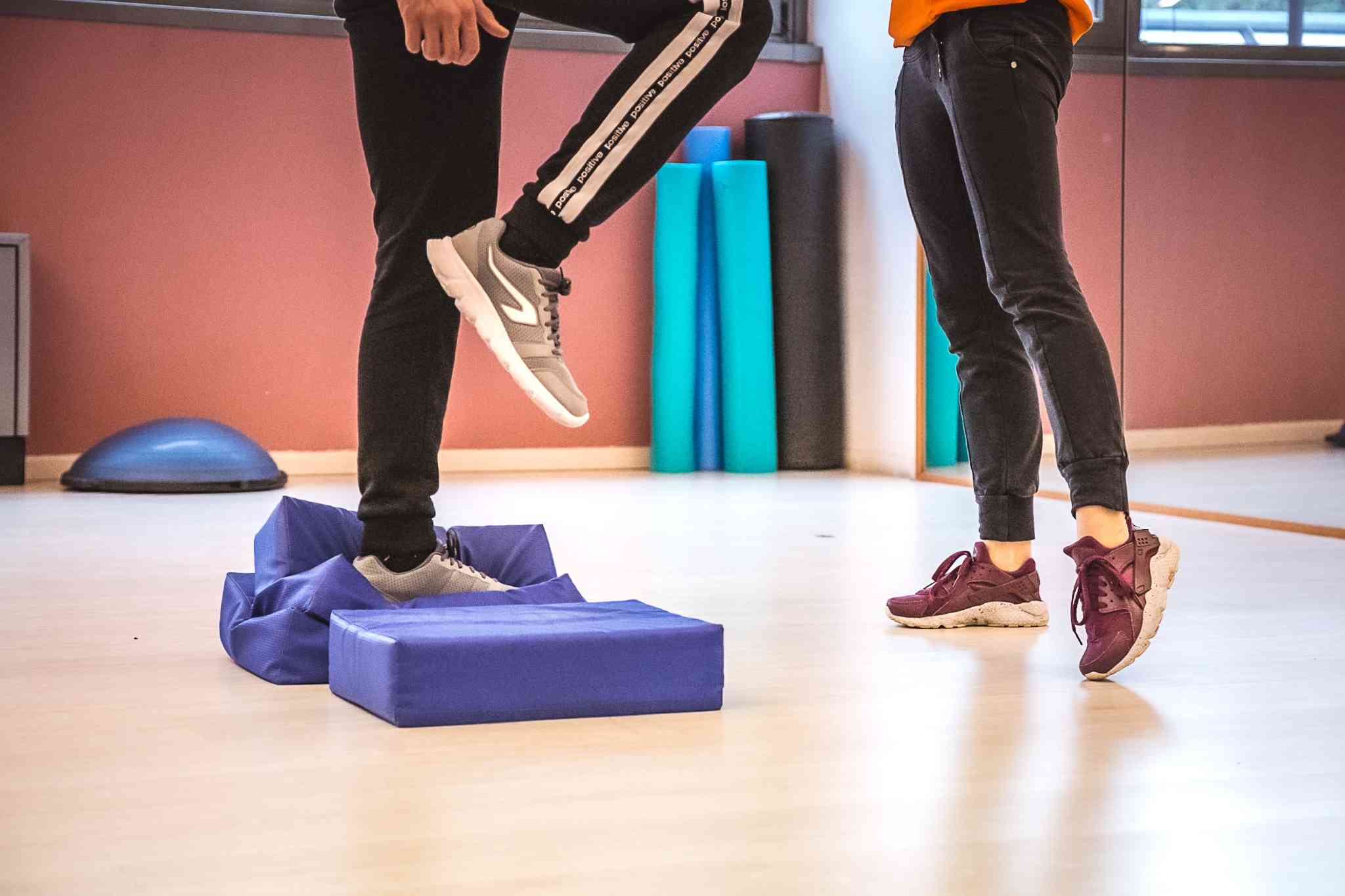
- Physical Therapy “FORCED EXCERCISE” and “Cueing”. Cueing is one of the most effective ways to “bypass” the broken internal rhythm set by the Basal Gangola of the brain by using external signals. Such as ..
- Visual cue,: Laser pointers, floor tape, or stepping over an imaginary line.
this “tricks” the brain into thinking there is an obstacle (which should be avoided, this in effect calls on the problem solving frontal cortex, which then issues the “order” to lift the leg and step over the “obstacle” this forward momentum is normally maintained for 6 to 8 steps, then the frontal cortex hands the task back to the autonomous brain function which (unless situation changes) is still “broken” and a freeze is again activated requiring the same “obstacle” approach as before. This explains why the most common and effective” Unblocking” technique is if a spouse or friend puts his foot in front of your foot (so creating an actual obstacle). This need for a second person does make life easier but the spouse, more tiresome and difficult as every 6 to 8 paces he or she must be available to do the foot block tecniche again! - Auditory cues: Walking to the beat of a metronome or rhythmic music. Army march music has been shown particularly effective as has singing to a favorite song.
Phycological cues
“I am going to freeze, I can feel it” and then you do is a common aspect especially if you believe that Parkinson’s must be a terrible disease, You freeze. At our centre we explain that the very fear of Parkinson’s is part of the mechanism of freezing and we try clients to overcome this fear.
At the European Centre we has just such a case and It took us three days and many songs to work out that she blocked almost at will, through anxiety or self–conviction. Whilst our singing improved, she did not. She hated her routine to be broken, and just like a child would throw a tantrum; she would block and there she would remain, still singing along to the chorus–lines but not moving.
On the last day, we needed to convince her that her blocking was caused partly by self–conviction and stress. So we unexpectedly changed the time of an appointment, added that she needed to stay through lunch for some tests, and watched as she became agitated and then went rigid as she found herself blocked again. If she could convince herself to block, she could convince herself to move, with or without our rendition of ‘Hit Me Baby One”. Indeed, we proved this point in her second week and she returned home with the knowledge and ability to limit freezing episodes.
Effective unblocking strategies

There are indeed many ways to avoid or limit freezing, we have mentioned a few The best we shall save to last.
Avoiding stress
The most popular amongst clinics is the The 5S Method. This is the most widely recommended immediate response to a freeze. It is designed to reset the motor system through a logical sequence of events
- STOP. Stop trying to move forward immediately. Reduces tension that locks muscles tighter.
- STAND TALL in other words, straighten your posture and look at the horizon. This Resets your centre of gravity
- SHAKE/SIGHT a deep breath or shake out your hands. Releases physical tension and resets the “anxiety-freezing” loop.
- SHIFT/ROCK your weight from side to side (left to right). This will result in your stepping” leg so it is free to move.
- STEP Take one BIG marching step forward. Uses a conscious, goal-directed movement rather than an automatic one. Proactive thought.
We had one client who had the correct and brilliant idea of attaching coca cola bottles under his walker and each step he aimed to kick the right or left bottle. Not a classic technique but very effective.
If you cannot move forward try side stepping and then step forward.
Counting out load one two THREE (moving on three)
The straight line with marks to help Pace length. The best techniques involve marks on the floor.
Especially effective is buying white and black tiles and in narrow area’s placing them (sticking them) to the floor to break the monotone colour of the floor so providing visual cues. One curious aspect is that freezing of gait rarely happens when climbing or descending stairs. This may be because stairs in themselves are cues offering lines and adaptative strategies. There are gadgets which promise great results.
What to do during an episode of Freezing
Do not Panic, indeed relax your mind and muscles. Think about and imagine you applying an unblocking technique, feel confident it will work. Then go through one of the actions above believing you will unblock.
If episodes become frequent or difficult to manage, it is important to seek medical advice.
How to prevent freezing of gait
Many freezing episodes are triggered by specific surroundings. Modifying your home can reduce these “trigger points.”
Keep it clear: Remove clutter, throw rugs, and narrow furniture arrangements. Freezing often occurs in tight spaces or doorways.
Improve Lighting: Dimly lit areas can cause hesitation. Ensure hallways and transitions between rooms are bright.
Visual Cues: Place strips of brightly coloured tape or tiles on the floor in areas where you often freeze (like the kitchen or bathroom). Stepping over a line is often easier for the brain to process than simply walking.
When and what help do you need for freezing of gait
When you a suffering from serious freezing episodes and are unable to cope and your quality of life is affected.
The most effective help may not be from your Neurologist, though they should be high on your list as “wearing off” of levodopa may play a big part.
A Neurological Physiotherapist (Neurotherapist) with specific training in freezing of gait are not so easy to find but are the best with experience in this specific area.
Always consult a qualified healthcare professional to determine the most appropriate treatment for your condition.
FAQ
How long can an episode last?
10 seconds is normal, it may extend to over a minute. In rare cases normally associated with “off periods” or severe stress, it can be much longer into minutes. If episodes become longer or more frequent, consulting your doctor is strongly recommended.
Is it dangerous?
No in itself it is not dangerous, although there are increased risks of falling, which may lead to injury. For this reason, discussing prevention strategies with a healthcare professional is advisable.
Can you eliminate Freezing?
It is unusual that freezing will completely disappear without specific interventions (like DBS Deep Brain Stimulation), you can certainly learn to reduce the risk of freezing, by lines on the floor, lowering your stress response and avoiding narrow spaces. A neurologist can help evaluate the most suitable treatment options.
Do cueing gadgets work?
If you have been trained to respond to outside gadgets like laser pens, eye glasses that overlay lines on the floor, vibration devices, audible sound devices may also work to a degree. Virtual reality glasses are under research development and may offer a more effective response. It is always best to consult a specialist before relying on these devices as part of your management plan.