Table of contents
Medical Disclaimer:
The information provided here is for educational purposes only and does not replace professional medical advice, diagnosis, or treatment. Always consult your doctor or neurologist for personalised guidance, especially if symptoms worsen or change.
Comprehensive Briefing: Managing Parkinson’s Disease During Travel and Transit
Planning
Managing Parkinson’s disease (PD) during travel requires proactive planning and a multi-layered approach to medication, mobility, and safety. The primary risks during travel include medication timing disruptions, increased fatigue, and exacerbation of symptoms such as freezing of gait (FOG) and orthostatic hypotension (OH).
Critical takeaways include:
* Proactive Planning: Engaging neurologists 4–6 weeks prior to departure to establish a medical summary, a “rescue strategy” for delayed doses, and a plan for shifting time zones.
* Medication Fidelity: Maintaining a strict schedule using alarms and ensuring all medications remain in carry-on luggage in their original labeled containers to comply with international regulations.
* Mobility and Safety: Utilizing available assistance services (e.g., airport wheelchairs, TSA Cares) and implementing “cueing” strategies or specialized exercises to combat stiffness and freezing.
* Risk Mitigation: Addressing the increased risk of deep vein thrombosis (DVT) during long-haul travel through hydration and frequent movement, particularly for those recovering from recent orthopedic surgeries.
1. Pre-Travel Planning and Documentation
Successful travel with Parkinson’s is predicated on thorough preparation beginning weeks before departure.
Clinical Coordination
* Neurologist Consultation: Schedule an appointment 4–6 weeks out to confirm health stability and review medication supplies.
* Medical Summary Letter: Obtain a doctor’s letter detailing the diagnosis, specific medications (generic and brand names), potential complications, and implanted devices like Deep Brain Stimulation (DBS) systems.
* Local Healthcare Mapping: Identify healthcare facilities at the destination and save their contact details. For international travel, use translation tools to communicate medical needs.
Documentation Requirements
* Medication Cards: Carry a card (such as the PSCNO Medication Card) listing emergency contacts and current prescriptions.
* Travel Insurance: Ensure coverage includes pre-existing conditions, theft of medication, and medical repatriation.
* Digital Backups: Store photos of prescription labels and medical summaries on a smartphone under “Emergency Information.”
2. Medication Management and Regulatory Compliance
Medication is the most critical element of a travel itinerary. Disruptions to the “on” time schedule can lead to severe symptom flare-ups.
Transport and Storage
* Carry-on Only: Never pack PD medications in checked luggage. Split the supply into two different carry-on bags to mitigate the risk of loss or theft.
* Original Packaging: Keep all pills in their original pharmacy-labeled bottles. Using pill organizers while crossing international borders can lead to delays or confiscation by customs.
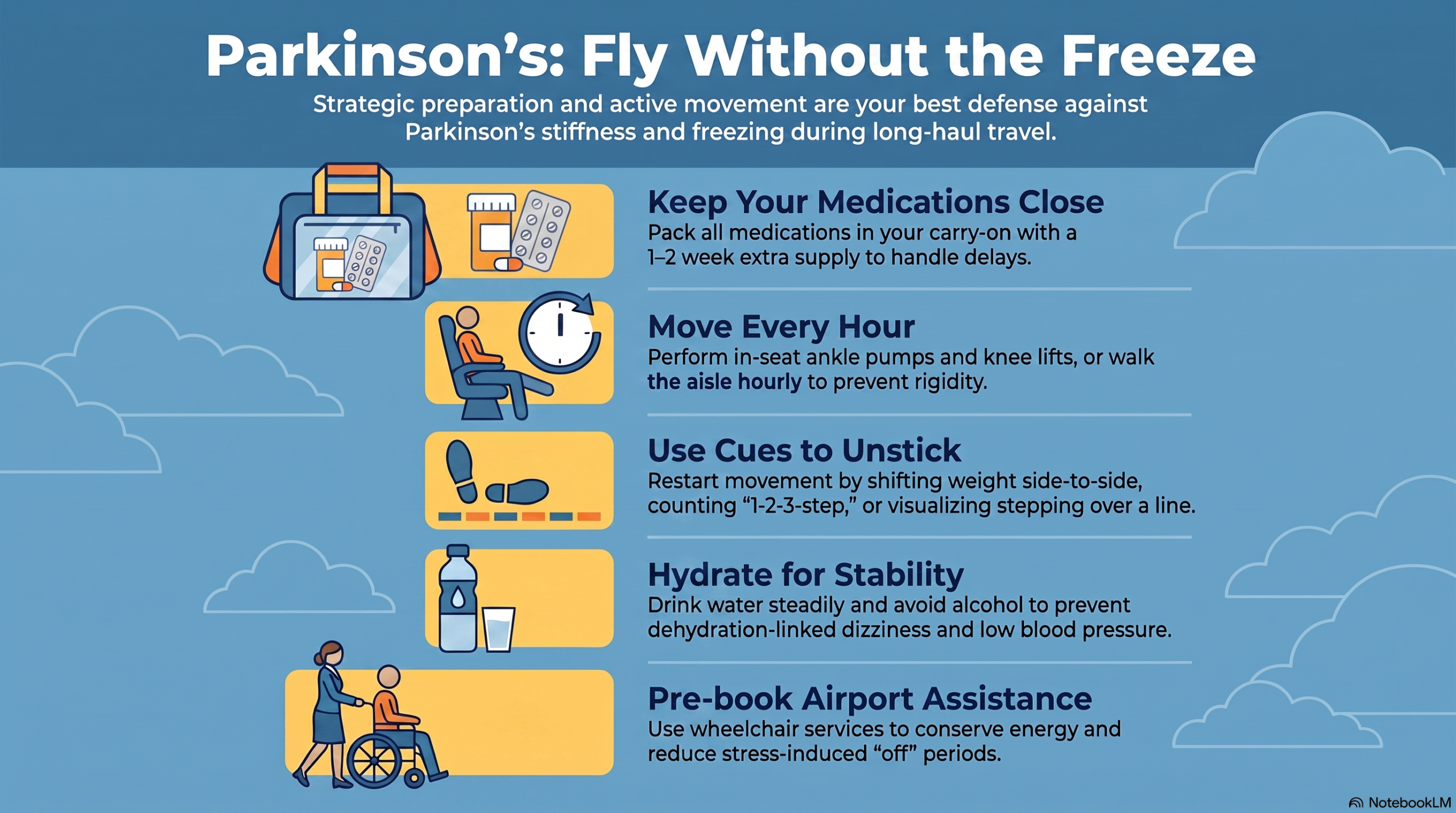
* Quantity: Bring at least twice the amount of medication anticipated for the duration of the trip (or a minimum of 1–2 weeks extra) to account for delays.
* Temperature Control: Protect medications from direct sunlight and extreme heat (e.g., avoid car glove boxes).
Time Zone Adjustments
A common strategy for adjusting medication across time zones involves the following:
* Gaining Time (Traveling West): Add one dose for every 3–5 hours gained.
* Losing Time (Traveling East): Remove one dose for every 3–5 hours lost.
* Grid Planning: For complex schedules, create a one-page dosing grid and set alarms on a watch or phone.
International Restrictions
Certain common PD medications or associated treatments (sedatives, stimulants) may be restricted in specific countries.
* Controlled Substances: Travelers in the Schengen Zone may require a specific certificate for controlled meds, often limited to a 30-day supply.
* Verification: Check the International Narcotics Control Board (INCB) or destination embassy for country-specific regulations.
3. Transportation Logistics and Assistance
Utilizing specialized services reduces the “friction” and stress that often worsen PD symptoms.
Air and Rail Travel
* Assistance Services: Pre-book airport wheelchairs and luggage lifts. These services remove time pressure and provide access to faster routes through terminals.
* TSA Cares: Contact TSA Cares 72 hours before flying to request assistance at security checkpoints.
* Seating Strategy: Request aisle seats near the front of the cabin for easier access to restrooms and more legroom, while minimizing the distance to exits.
* Hidden Disabilities: Wear a “Hidden Disabilities Sunflower” lanyard to discreetly signal to staff that extra time or assistance may be required.
4. Clinical Symptom Management in Transit
Environmental stressors and prolonged immobility can exacerbate specific Parkinson’s symptoms.
Freezing of Gait (FOG)
Freezing often occurs at transitions (e.g., moving through narrow doorways, elevators, or crowded customs lines).
* Cueing Strategies: Use visual cues (stepping over a line or laser), auditory cues (counting “1-2-3-step” or using a metronome), or mental imagery.
* Technology: Devices like NexStride use a green laser to project a “goal line” on the floor, bypassing damaged neural pathways to trigger movement.
* Immediate Action: If frozen, stop and remain calm. Shift weight from side to side rather than trying to force a forward step.
Orthostatic Hypotension (OH)
OH is a drop in blood pressure upon standing, caused by a norepinephrine deficiency in the autonomic nervous system.
* Hydration: Drink at least 8 ounces of water with meals and several more throughout the day.
* Movement: Transition slowly from lying to sitting, and sitting to standing.
* Dietary Adjustments: Eat small, frequent meals and avoid alcohol or extremely hot food/showers, which can trigger blood pressure drops.
Deep Vein Thrombosis (DVT) and Rigidity
Prolonged sitting in planes, cars, or trains increases the risk of blood clots and muscle cramping.
* Clot Prevention: Wear graduated compression stockings and stay hydrated.
* “Sit and Stretch” Routine:
* Ankle Circles: Rotate feet in each direction for 15 seconds.
* Foot Pumps: Alternately lift heels and toes while keeping the balls of the feet on the floor.
* Knee Lifts: Contract the thigh while lifting the knee.
* Shoulder/Neck Rolls: Gently roll the neck and hunch shoulders to relieve tension.
5. Safety and Security Considerations
Deep Brain Stimulation (DBS) Precautions
* Screening: DBS patients should generally avoid traditional metal detectors. Request a manual pat-down and inform TSA agents of the implanted neurostimulator.
* Documentation: Carry the device manufacturer’s card, including any MRI or X-ray warnings.
Medical Identification
* Medical IDs: Wear a medical ID bracelet or program “Emergency Information” into a smartphone to alert responders to the PD diagnosis if the traveler becomes incapacitated.
* Assistance Tools: For those with tremors, use paper boarding passes rather than digital versions to avoid the difficulty of navigating phone apps under stress.
Physical Safety and Surgical Risks
* Post-Surgery Travel: Patients traveling 6–8+ hours for orthopedic surgery (e.g., hip or knee replacement) are at significantly higher risk for clotting. Clotting systems “rev up” after bone cutting, and immobilization further increases risk.
* Fainting Response: If feeling dizzy or like a fall is imminent, sit down immediately—even if it requires sitting on the floor—to prevent injury.