
Table of contents
Medical Disclaimer:
The information provided here is for educational purposes only and does not replace professional medical advice, diagnosis, or treatment. Always consult your doctor or neurologist for personalised guidance, especially if symptoms worsen or change.
Driving with Parkinson’s: safety tips and when to stop
The Strategic Intersection, Parkinson’s and Public Safety, the law of disclosure.
This requires a clear answer: the ability to drive is an economic and social lifeline, but it is also a significant legal liability when compromised by a neurodegenerative condition. Data indicates a stark reality for those navigating the aging process: on average, women outlive their ability to drive safely by 9.4 years, and men by 6.2 years.
A diagnosis of Parkinson’s Disease—a central nervous system disorder that progressively weakens nerve cells and impairs motor control—necessitates a strategic pivot in how you manage your “duty to report.”
In this high-stakes environment, transparency is not a path to immediate forfeiture; it is a vital strategy for asset protection. By proactively disclosing your condition to the proper authorities, you establish a managed safety baseline. Failure to do so does more than risk a fender bender—it strips away your legal and financial defenses in the event of an accident. Balancing your personal freedom against the collective security of the road requires an authoritative commitment to honest medical reporting.
2. Reporting Obligations:
The Strategic Multi-Tiered Approach
Navigating the legal landscape of Parkinson’s requires a synchronized reporting strategy involving medical experts, licensing boards, and instructional specialists.
Reporting to the Neurologist/Health Care Provider
To Your Neurologist/physician; you must report:
Sudden and Excessive Sleepiness: Specifically associated with dopamine agonists, which can induce sleep “attacks” without warning.
Visual and Cognitive Fluctuations: Including blurred vision, dizziness, confusion, or memory impairment.
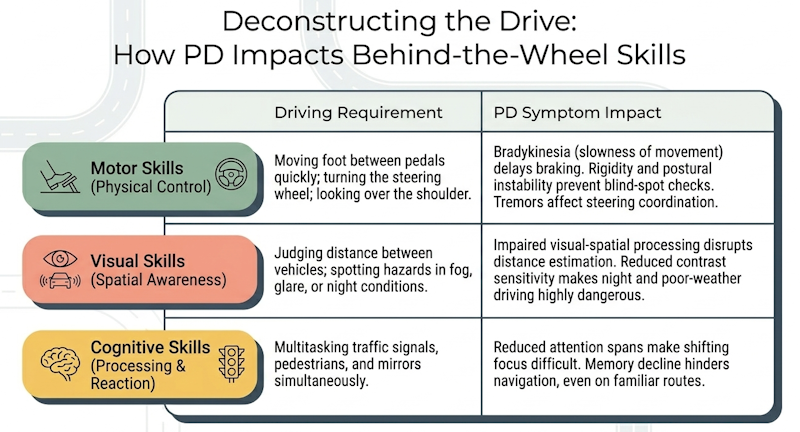
“Off” Period Performance: Any instance where tremors, rigidity, or bradykinesia (slowed movement) interfere with your reaction time or pedal control.
Reporting to the Police and Licensing Authorities
Jurisdictional protocols vary, and ignorance of local statutes is never a valid legal defense.
Self-Reporting Models: In states like Colorado, the driver is legally obligated to disclose their condition.
Referral Models: In Washington, the Department of Licensing (DOL) utilizes a “Driver Evaluation Request” system, where any concerned party (including physicians or law enforcement) can trigger a review.
Mandated Reporting: Jurisdictions like Ontario, Canada, operate under a medical mandate where physicians must report unfit drivers to the Ministry of Transportation.
To learn the protocol for your region, you must contact your DMV or Ministry of Transportation and request information regarding the Physical Examination Report required for medical reviews.
Reporting to Driving Instructors and Specialists
A Certified Driver Rehabilitation Specialist (CDRS) or Occupational Therapist (OT) provides the objective, clinical data necessary to defend your fitness to drive. By conducting professional assessments, they establish a legal “safety baseline” that can potentially extend your driving years through validated vehicle modifications.
3. Jurisdictional Analysis: USA, England, and Italy
Medical fitness standards are governed by regional statutes, but truthfulness is a universal requirement for license renewal. If you fail to disclose a diagnosis during renewal, your license may be deemed fraudulent, nullifying your legal standing.
The United States Perspective (Colorado and Washington)
In the U.S., assessments often lead to specific, measurable restrictions linked to your DMV profile. In states like Washington, if a Physical Examination Report is received from a provider, the DOL will follow up with mandatory next steps.
Common License Restrictions and Requirements
• Restriction Type
• Legal Description
• Daylight Only
• Driving is restricted to sunrise-to-sunset to mitigate reduced contrast sensitivity.
• Specific Radius
• Operation is limited to a defined distance (e.g., 5 miles) from the primary residence.
• Speed Limits
• Prohibition from high-speed corridors or highways.
• Mechanical Appliances
• Use of adaptive equipment; the applicant must demonstrate ability in a driving test after installation.
England, Italy, and the International Protocol (CCMTA Model)
For those in jurisdictions following the Canadian/International (CCMTA) model, the standard is rigorous. Under CCMTA Section 6.6, if a progressive disease is accompanied by a slowing of the thought process, impairment of memory, or poor judgment, the applicant cannot safely drive any type of motor vehicle.
Verification Checklist for International Compliance:
Individual Eligibility: Determine if your local authority evaluates eligibility based on the “degree and severity” of coordination and muscle control disorders.
Disclosure Mandate: Confirm if your country requires formal disclosure during the renewal cycle.
Re-examination Intervals: For progressive conditions like Parkinson’s, many jurisdictions require re-evaluation every six months to ensure continued fitness.
Medical Review Section: Identify if a formal specialist report is required to maintain your file.
4. The Critical Implications of Non-Disclosure: Legal and Insurance Risks
The “Strategic Why” behind reporting is simple: the preservation of your financial and personal liberty.
Insurance Implications
Non-disclosure is a breach of contract. If an “at-fault accident” occurs due to unreported symptoms, your insurer has grounds to deny coverage entirely. You will be held personally and financially liable for all damages, medical costs, and litigation.
Legal and Criminal Liability
Driving while impaired by prescription medication is a prosecutable offense.
WARNING It is a criminal offense to operate a vehicle if you are rendered unfit by legal prescription drugs. Specific Parkinson’s medications—such as selegiline (an amphetamine) or clonazepam—can lead to DUI charges and criminal prosecution if they impair your ability to operate the vehicle safely.
Public Safety Risk
Disregarding impairment is evidence of negligence. Expert markers of impairment include:
Spatial Confusion: Drifting across lanes, difficulty with left-hand turns, or misjudging the distance of cyclists and pedestrians.
Response Failures: Stopping at green lights, forgetting to check mirrors/blind spots, or slow reaction to traffic hazards.
Cognitive Decline: Frequent near-misses and getting lost on familiar routes.
-
5. Professional Assessment and Transition Strategies
Accepting the results of a professional assessment is a selfless act of compassion for your community and a strategic move to avoid the trauma of a preventable tragedy.
The Assessment Process
A CDRS uses specific, high-level evaluative tools to determine fitness. The process is three-fold:
Clinical Assessment: Utilizing the Montreal Cognitive Assessment (MoCA) (where a score of 18 or less indicates significant risk), the Clock Drawing Test, and the Trails B (Trail Making Test) to measure executive function and reaction time.
On-Road Evaluation: An hour or more of real-world driving to observe limb coordination and hazard perception.
Professional Review: The CDRS provides findings, but the final determination of fitness is made by your physician and the licensing authority.
Independence Preservation Options
If retirement from driving is recommended, the goal shifts to “Independence Preservation.” Relinquishing the keys is not an end to mobility; it is a transition to safer modes of engagement: - Rideshare & Technology: Services like Uber/Lyft (utilize a care partner for account setup and initial training).
- Public and Para-transit: Specialized door-to-door services for those with disabilities.
- Volunteer & Community Programs: Free or low-cost transport offered by senior centers or religious organizations.
- Adaptive Mobility: Transitioning to eBikes or walking tours to maintain local engagement.
- Summary: Retiring from driving is a profound transition, but it is a commitment to safety over ego. Foregoing the use of your automobile may save your life or the life of someone you love. Giving up your license does not mean giving up independence; it is a selfless act of responsible citizenship.
Driving with Parkinson’s: safety tips and when to stop
Introduction:Checks and Changes for Your Alertness
• Drive only during “on” periods: You should time your driving to coincide with the periods when your Parkinson’s medications are working optimally, and strictly avoid driving during “off” periods when your symptoms return.
• Monitor for sleepiness and medication side effects: Because Parkinson’s drugs (particularly dopamine agonists) can cause sudden and excessive daytime sleepiness, dizziness, or confusion, you must check in with how you are feeling before you get behind the wheel. Avoid driving if you are tired or not well-rested.
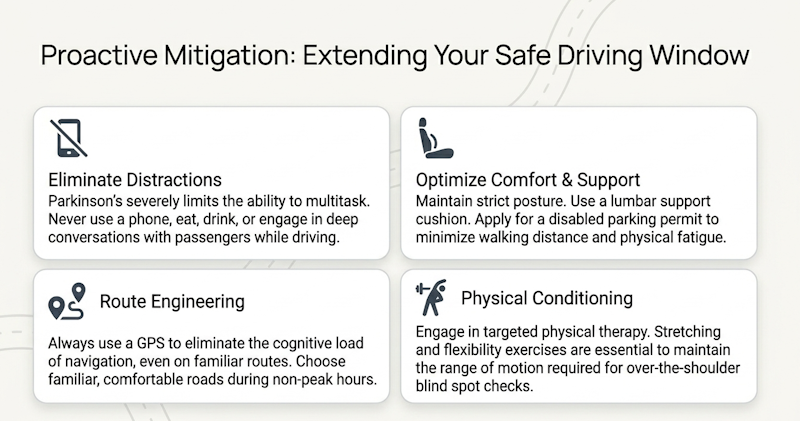
• Eliminate in-car distractions: Parkinson’s can diminish your ability to multitask, so you should stop eating, talking with passengers, using your phone, or adjusting the radio while driving.
• Do a self-assessment and ask for feedback: Ask yourself if you are feeling easily stressed, getting lost, or feeling sleepy while driving. Additionally, ask a trusted friend or care partner to ride along and objectively evaluate your alertness, reaction times, and on-road decision-making.
• Plan your trips carefully: Stick to shorter, familiar routes, and avoid driving in bad weather, at night, or during peak traffic times when visibility or road demands might overwhelm your focus.
Checks and Changes for Your Car
• Use comfort aids: Adjust your seat to maintain good posture and consider adding a lumbar support cushion to improve your physical comfort while driving.
• Utilize a GPS system: Installing or using a GPS can help you plan your routes in advance so you do not have to worry about navigating or getting confused.
• Explore vehicle modifications: If you are experiencing physical limitations, such as trouble turning the steering wheel or operating the foot pedals, it is highly likely that your vehicle can be modified to accommodate you. You can work with an occupational therapist or a Certified Driver Rehabilitation Specialist (CDRS) who can evaluate your needs and train you in the use of adaptive equipment.
• Prepare for a driving test with new equipment: If you do have mechanical appliances or modifications installed in your vehicle, be aware that you will generally need to demonstrate your ability to safely use them during an official driving test.
• Apply for a disabled parking permit: Getting a permit can allow you to park in larger spaces closer to your destinations, which can help conserve your energy.
Reviewing your license . >The players
A “legal” pill does not grant immunity if it compromises public safety.
. • Neurologist: Manages the diagnosis and determines if disease progression or medications warrant a formal assessment.
• Occupational Therapist (OT): Evaluates functional skills, strength, and strategies for physical/cognitive challenges.
• Certified Driver Rehabilitation Specialist (CDRS): Conducts comprehensive testing to determine behind-the-wheel competence.
Alternatives