Table of contents
Medical Disclaimer:
The information provided here is for educational purposes only and does not replace professional medical advice, diagnosis, or treatment. Always consult your doctor or neurologist for personalised guidance, especially if symptoms worsen or change.
Parkinson’s Progress: A Guide to Advanced Therapeutic Horizons
1. The “Wearing Off” Phenomenon: Understanding the Need for Advanced Care
In the early chapters of a Parkinson’s journey, standard oral medications like levodopa act as a reliable lifeline. However, as time passes, the “therapeutic window” can narrow. This transition is not a failure of your treatment; rather, it is a biological signal that your body is ready for a more sophisticated “bridge” to maintain stability. When the predictable relief of a pill begins to fade before the next dose is due, we enter the realm of motor fluctuations.
“Wearing Off” is the return of motor symptoms—such as tremor, stiffness, or slowness—because the effect of a levodopa dose does not last until the next scheduled dose is taken.
At the ReGen Centre, we view these fluctuations as a doorway to advanced care. We look for three primary signs that a patient is ready to transition to more consistent delivery technologies:
- Persistent “Off” Time: Experiencing three or more hours of “Off” symptoms daily, even with an optimized pill schedule.
- Troublesome Dyskinesia: Involuntary, “fidgety” movements that occur when medication levels peak, often becoming as disruptive as the disease itself.
- Medication-Resistant Symptoms: Specific symptoms, like a persistent tremor, that no longer respond satisfactorily to standard oral doses.
While pills have natural limits due to how the digestive system processes them, modern technology offers a way to bypass these hurdles, ensuring a steady state of well-being rather than a rollercoaster of symptoms.
2. The Chemical Shield: Continuous Medication Infusion Pumps
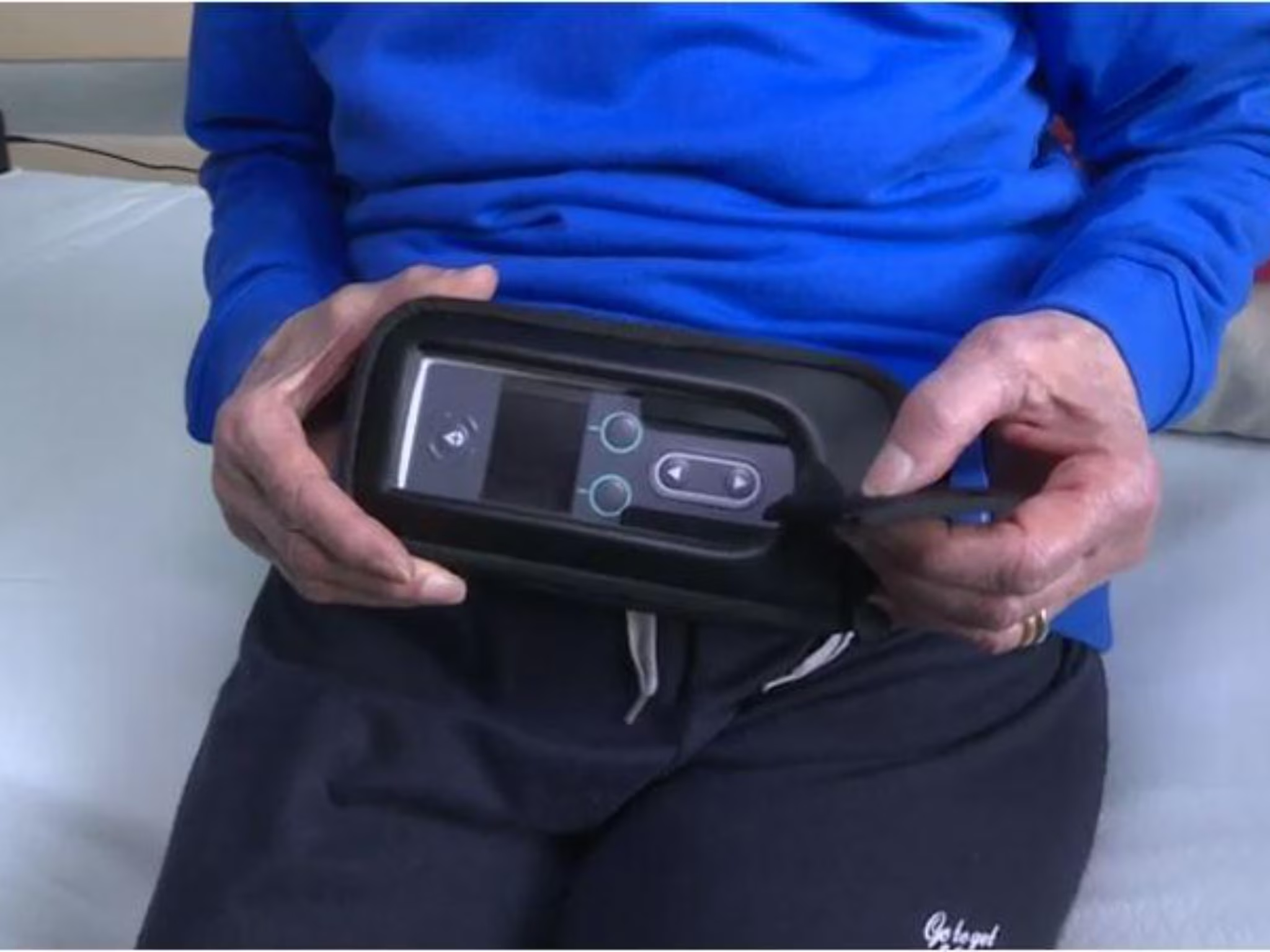
When the “peaks and valleys” of oral dosing become too steep, infusion pumps offer a “Chemical Shield.” By providing a steady, automated flow of medication, these devices mimic the natural, constant release of dopamine in a healthy brain.
|
Technology Name
|
Delivery Method
|
Surgical Requirement
|
Key Learner Insight
|
|---|---|---|---|
|
Produodopa (VYAFUSER)
|
Subcutaneous (Under the skin)
|
None
|
A “pro-drug” (foslevodopa) that the body converts into dopamine naturally; smaller and more flexible than older pumps.
|
|
Duodopa (LCIG)
|
Intestinal (Direct to Jejunum)
|
Yes (PEG-J Tube)
|
The “gold standard” for direct absorption; avoids the “gut-emptying” delays that hinder pills.
|
|
Apomorphine Pump
|
Subcutaneous (Under the skin)
|
None
|
A dopamine agonist used for 20+ years; significantly lower cost (1/3 of Produodopa) but is not a natural dopamine precursor.
|
The Produodopa Breakthrough Clinicians often prefer Produodopa because it is a “pro-drug” (foslevodopa/foscarbidopa). Unlike agonists that merely mimic dopamine, Produodopa is a natural precursor that the brain converts into dopamine itself. Using the VYAFUSER pump, this medication is delivered through a small needle under the skin, offering a non-invasive alternative to the surgical tubes required by the Duodopa system.
While these pumps manage the body’s chemistry to maintain a steady state, another path to stability involves re-tuning the brain’s internal electrical signals.
3. The Electrical Symphony: Deep Brain Stimulation (DBS)
Deep Brain Stimulation (DBS) acts as a “pacemaker for the motor brain.” It involves the placement of thin wires that provide reversible modulation to specific circuits. By adjusting these electrical impulses, we can smooth out the “Electrical Symphony” of the brain.
The Targets: STN vs. GPi
- STN-DBS (Subthalamic Nucleus): Often called the “medication-saver.” It is highly effective at reducing the total daily “pill burden” and improving motor scores.
- GPi-DBS (Globus Pallidus Internus): Known as the “mood-balancer.” Clinical evidence from the European Academy of Neurology suggests that GPi-DBS may provide a minor improvement in depression and mood compared to STN targets, though it typically allows for less reduction in daily medication.
The 3 Pillars of DBS Success
- Levodopa Responsiveness: The best predictor of success is how well your symptoms currently improve during your “On” periods with medication.
- Fluctuation Control: DBS is specifically designed to eliminate the “Off” time and the dyskinesia that follows oral dosing.
- Quality of Life (QoL): The ultimate goal is a measurable increase in your ability to enjoy daily activities.
A Vital Note on Timing: International guidelines explicitly state that DBS should not be offered to patients in the early stages of Parkinson’s who do not yet experience motor fluctuations. The goal is to solve a specific problem—instability—that has not yet emerged in early-stage disease.
As we move beyond “re-tuning” the brain’s wires, the final category of treatment involves permanent, precision interventions.
4. Precision Sculpting: Lesional and Incisionless Therapies
In contrast to the reversible wires of DBS, lesional therapies involve “Precision Sculpting.” These treatments create a permanent, tiny change in specific brain tissue to interrupt the signals that cause tremors or stiffness.
- Radiofrequency Thermocoagulation: A traditional method requiring a “burr hole” in the skull to insert a heated probe. While effective, it is largely reserved for cases where other technologies aren’t an option.
- MRgFUS (Magnetic Resonance-guided Focused Ultrasound): A modern, incisionless breakthrough. It uses high-energy ultrasound beams to create a precise lesion without a single cut.
The Clinical Stance on MRgFUS Current expert task forces recommend MRgFUS for specific symptoms. MRgFUS of the thalamus is used to target medication-resistant tremors, while MRgFUS of the STN is considered for motor symptoms in patients with distinctly unilateral (one-sided) disease. Because these effects are permanent and data is still emerging, they are currently best used within clinical registries.
By “sculpting” tissue or “re-tuning” signals, these physical interventions provide a non-chemical alternative to the infusion pumps discussed earlier.
5. Choosing the Path: Comparative Synthesis for the Learner
Selecting the right therapy is a collaborative process that balances your clinical needs with your lifestyle preferences.
Quick-Reference Decision Matrix
|
If You Prefer…
|
Recommended Path
|
Primary Consideration
|
|---|---|---|
|
No Surgery
|
Produodopa or Apomorphine Pump
|
Requires wearing a small external device daily.
|
|
No External Device
|
DBS or MRgFUS
|
A one-time procedure to “set and forget” the treatment.
|
|
To Minimize “Off” Time
|
Produodopa or STN-DBS
|
Focuses on maintaining a continuous “On” state.
|
|
Tremor Focus
|
Thalamic MRgFUS or DBS
|
Targets the specific circuit responsible for shaking.
|
Synthesis Checklist: 3 Factors in Therapy Selection
- Symptom Profile: Are we treating “wearing off” fluctuations, dyskinesia, or a resistant tremor?
- Biological Age & Health: Clinicians look at your “biological age” (overall vitality and cognitive health) rather than just the number of years.
- Lifestyle Synergy: Are you more comfortable managing a small pump and needle, or do you prefer a surgical solution that requires no daily maintenance?
6. Looking Forward: The Optimistic Outlook
The success stories at the ReGen Centre reflect a thriving field of innovation. We are moving into an era where Parkinson’s is no longer just “managed” by pills, but stabilized by a suite of life-changing technologies tailored to the individual.
Top 3 Reasons for Optimism
- Biological Mimicry: New “pro-drug” infusions like Produodopa allow us to achieve a steady state using the body’s own natural dopamine pathways without surgery.
- Expanding Horizons: The upcoming launch of competitive technologies like ND-0612 ensures that devices will continue to become smaller, smarter, and more effective.
- Proven Durability: Evidence confirms that advanced interventions like STN-DBS remain effective for over 15 years, supporting quality of life long after the initial years of diagnosis.
Armed with this understanding, you can see that while Parkinson’s brings changes, modern technology provides the tools to ensure your journey remains one of hope, precision, and empowerment.